Tell us about the job
Takes about a minute. No obligation.
Sizing a mini-split in Cobb County means accounting for a climate that puts genuine but not extreme seasonal load on the equipment. 105 severe weather events were recorded in Cobb County, Georgia between 2015 and 2024. At that rate, severe weather is a steady background condition rather than a rarity, and a contractor working an installation here will factor it into where the outdoor unit goes and how the refrigerant lines are run. A unit placed without that in mind ends up working harder than it needs to from day one.
The electrical service in a house shapes what a mini-split installation can do before the unit is ever ordered. Half the homes in Cobb County, Georgia were built in 1990 or earlier (2020-2024 ACS 5-year). That puts a large share of Cobb County homes in a range where the panel and the branch circuits were sized for something other than modern ductless equipment. A contractor will open the panel, read what is there, and determine whether the existing service supports the new draw or whether the electrical work is the job that has to happen first.
What a Mini-split Installation Puts Where
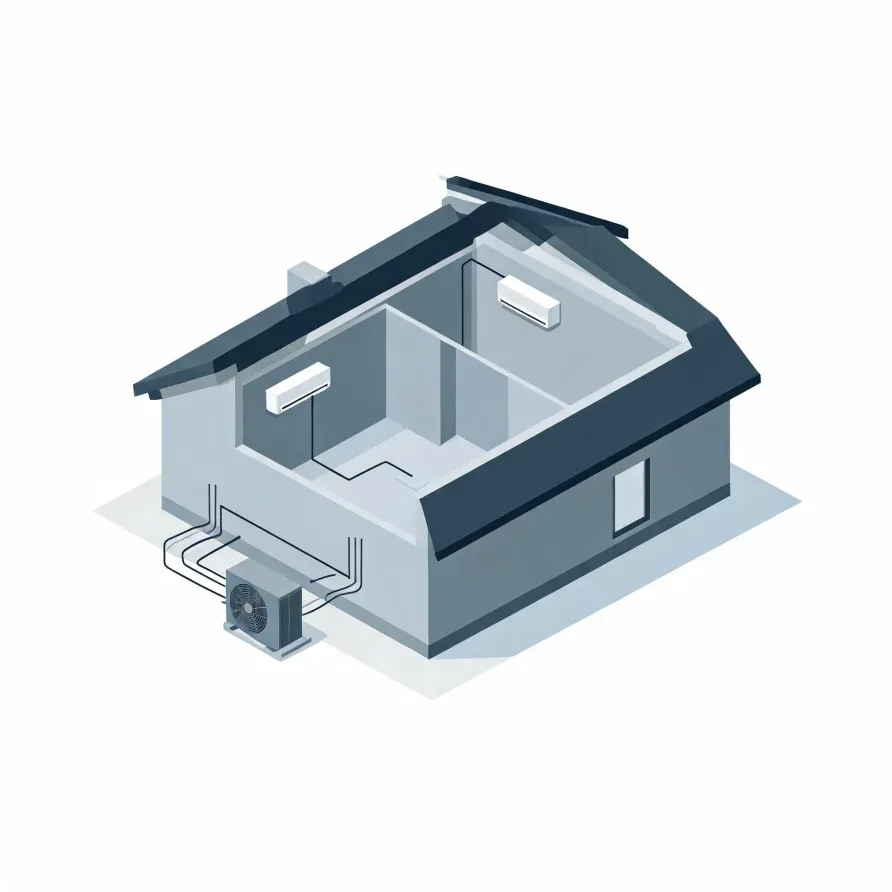
The indoor air handler mounts high on an interior wall, inside the room being conditioned, and moves air across the space. The outdoor unit sits on the ground or a bracket outside the home and houses the compressor and condenser coil. Each indoor unit you add serves a separate zone.
A refrigerant line set runs through a small hole in the wall to connect the indoor and outdoor units, carrying the working fluid between them. A condensate drain line runs from the indoor unit to the outside, clearing the moisture the air handler pulls from the air. A dedicated power line feeds the outdoor unit from the electrical panel.
The drawing shows the typical layout of these components, and a licensed contractor determines exactly how they are positioned and routed in your home.
Get matched in Cobb CountyCobb County, by the numbers
105 severe weather events were recorded in Cobb County, Georgia between 2015 and 2024.
NOAA National Centers for Environmental Information, Storm Events Database, bulk CSV export, events 2015-01-01 through 2024-12-31.Half the homes in Cobb County, Georgia were built in 1990 or earlier (2020-2024 ACS 5-year).
U.S. Census Bureau, 2020-2024 American Community Survey 5-Year EstimatesCobb County, Georgia holds 314,104 housing units (2020-2024 ACS 5-year).
U.S. Census Bureau, 2020-2024 American Community Survey 5-Year EstimatesOwners occupy 67.0% of the occupied homes in Cobb County, Georgia (2020-2024 ACS 5-year).
U.S. Census Bureau, 2020-2024 American Community Survey 5-Year EstimatesSevere Weather Events in Cobb County
Heating and cooling equipment carries the load that local weather imposes on it. A mini-split sized and installed for Cobb County's climate will handle that load differently than one specced for somewhere else, which is why weather history belongs on a page about this work.
105 severe weather events, 2015–2024. Source: NOAA National Centers for Environmental Information, Storm Events Database.