Tell us about the job
Takes about a minute. No obligation.
Sizing a mini-split in Dade County starts with what the house actually demands, not with a worst-case weather assumption. 73 severe weather events were recorded in Dade County, Georgia between 2015 and 2024. At that rate, severe weather is a real but irregular part of life for a system here, so a contractor's first job during installation is matching capacity to the structure's envelope and orientation. A unit undersized for the floor plan will run hard regardless of what the sky does. Getting that calculation right before the equipment goes up is where the local work actually lives.
Older electrical panels are where mini-split installations in Dade County most often stall. Half the homes in Dade County, Georgia were built in 1987 or earlier (2020-2024 ACS 5-year). A house from that period was wired around the demands of its time, and a modern mini-split's outdoor unit draws on a dedicated circuit that may not exist and a panel that may not have the capacity to add one cleanly. The ductwork question does not apply here the way it would with a central system, but the electrical does, and a contractor quotes the wiring before they quote anything else.
What a Mini-split Looks Like Once It's In
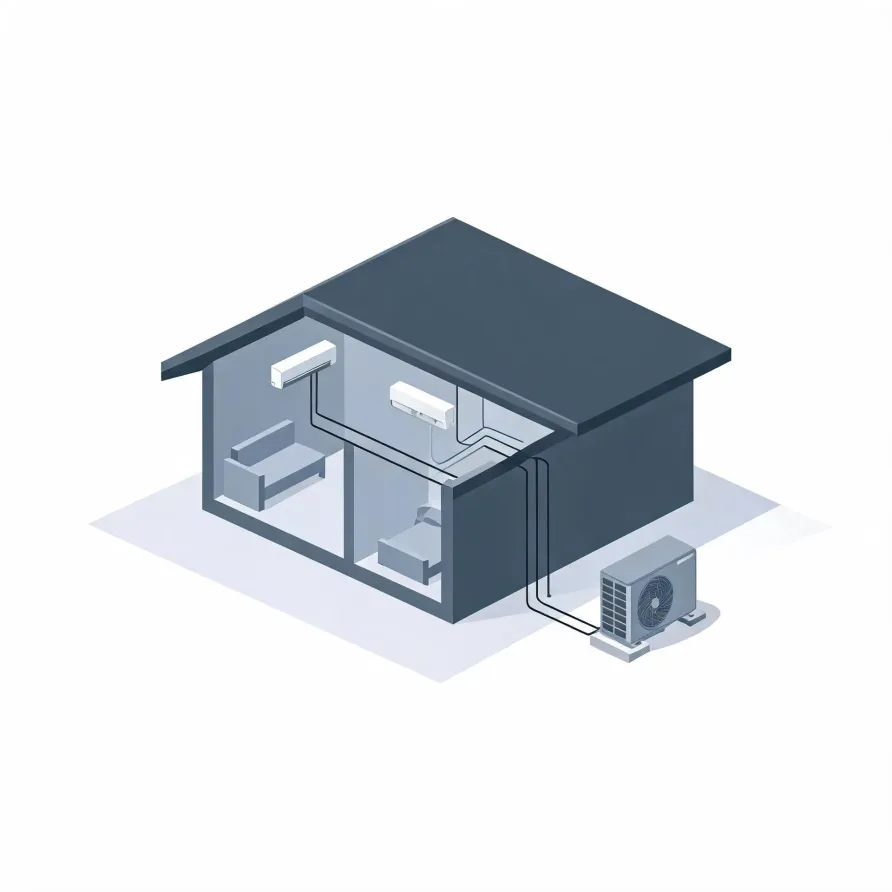
The indoor air handler mounts high on an interior wall in the room being conditioned. It draws room air across its coil and pushes treated air back into the space. The outdoor condenser unit sits on the ground or on a wall bracket outside, handling the exchange that makes the indoor unit's work possible.
A refrigerant line set runs through a small penetration in the wall to connect the two units. A condensate drain line exits the indoor unit through the same opening, carrying away moisture. The outdoor unit also has its own electrical disconnect box mounted nearby on the exterior wall.
The drawing shows a typical layout, and a licensed contractor determines exactly how each piece fits the conditions in your home.
Get matched in Dade CountyDade County, by the numbers
73 severe weather events were recorded in Dade County, Georgia between 2015 and 2024.
NOAA National Centers for Environmental Information, Storm Events Database, bulk CSV export, events 2015-01-01 through 2024-12-31.Half the homes in Dade County, Georgia were built in 1987 or earlier (2020-2024 ACS 5-year).
U.S. Census Bureau, 2020-2024 American Community Survey 5-Year EstimatesDade County, Georgia holds 7,431 housing units (2020-2024 ACS 5-year).
U.S. Census Bureau, 2020-2024 American Community Survey 5-Year EstimatesOwners occupy 80.0% of the occupied homes in Dade County, Georgia (2020-2024 ACS 5-year).
U.S. Census Bureau, 2020-2024 American Community Survey 5-Year EstimatesSevere Weather Events in Dade County
Weather in Dade County puts real demands on heating and cooling equipment, and those demands shape which systems hold up and how hard they have to work. A mini-split sized and installed for local conditions is a different decision than one picked off a spec sheet.
73 severe weather events, 2015–2024. Source: NOAA National Centers for Environmental Information, Storm Events Database.