Tell us about the job
Takes about a minute. No obligation.
A contractor quoting a mini-split install in Screven County cannot treat sizing as a catalog lookup. 120 severe weather events were recorded in Screven County, Georgia between 2015 and 2024. At that rate, severe weather is a standing condition of operating here, not an occasional disruption, and the load it places on a system across its life is built into every sizing and placement decision a contractor makes. A unit undersized for that demand runs longer at higher stress and reaches its limits sooner. Getting the install right from the start is the work that load makes necessary.
The electrical service in older Screven County housing was sized for whatever ran at the time it was built, and a mini-split draws differently than what those panels were laid out for. Half the homes in Screven County, Georgia were built in 1982 or earlier (2020-2024 ACS 5-year). A contractor quoting a mini-split installation here opens the panel early, because the circuit capacity decides whether the job is straightforward or whether it requires a service upgrade before anything else moves forward.
What a Mini-split Installation Puts in Your Home
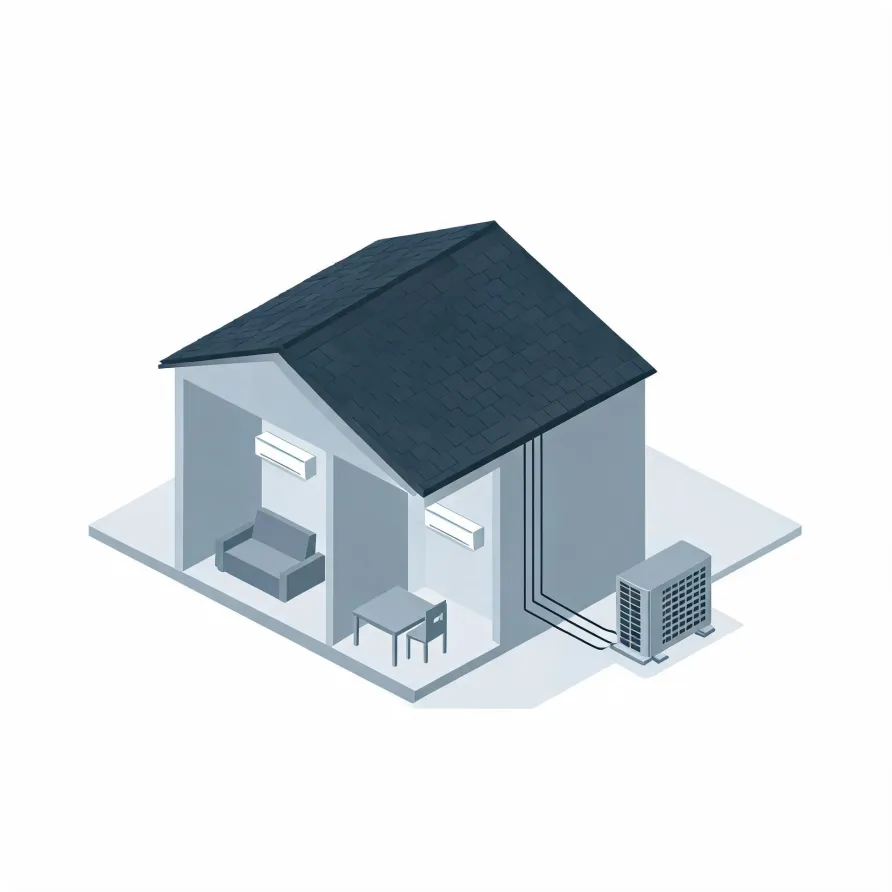
The indoor air handler mounts high on an interior wall in the room being conditioned, and it is the piece a homeowner sees every day. The outdoor unit sits on the ground or a bracket outside the building and holds the compressor and condenser coil. Together these two units do the work of moving conditioned air into the space.
A conduit runs through a small opening in the wall to connect the two units, carrying the refrigerant lines, a power cable, and a condensate drain line. A dedicated disconnect box is mounted on the exterior wall near the outdoor unit, giving the contractor a safe cutoff point close to the equipment.
The drawing shows a typical layout, and a licensed contractor determines exactly how each piece fits the conditions of your specific house.
Get matched in Screven CountyScreven County, by the numbers
120 severe weather events were recorded in Screven County, Georgia between 2015 and 2024.
NOAA National Centers for Environmental Information, Storm Events Database, bulk CSV export, events 2015-01-01 through 2024-12-31.Half the homes in Screven County, Georgia were built in 1982 or earlier (2020-2024 ACS 5-year).
U.S. Census Bureau, 2020-2024 American Community Survey 5-Year EstimatesScreven County, Georgia holds 6,567 housing units (2020-2024 ACS 5-year).
U.S. Census Bureau, 2020-2024 American Community Survey 5-Year EstimatesOwners occupy 69.8% of the occupied homes in Screven County, Georgia (2020-2024 ACS 5-year).
U.S. Census Bureau, 2020-2024 American Community Survey 5-Year EstimatesSevere Weather Events in Screven County
Weather in Screven County puts direct pressure on heating and cooling equipment, shaping how hard a system works and how long it lasts. A mini-split sized and installed for local conditions handles that pressure better than one that was not.
120 severe weather events, 2015–2024. Source: NOAA National Centers for Environmental Information, Storm Events Database.