Tell us about the job
Takes about a minute. No obligation.
A contractor quoting a mini-split installation in Union County is working from the house outward: room volume, sun exposure, insulation, and how the building actually holds or loses air. 60 severe weather events were recorded in Union County, Georgia between 2015 and 2024. At that rate, severe weather is a real but infrequent variable, not the defining condition a system has to be built around. The sizing math and the equipment selection here live mostly in the structure, which means a contractor who skips a load calculation is leaving the real work undone.
Electrical service in houses of this vintage was sized for what households drew at the time, and a mini-split's demands land differently against that baseline. Half the homes in Union County, Georgia were built in 1995 or earlier (2020-2024 ACS 5-year). A contractor pricing an installation here opens the panel before anything else, because the circuit capacity, not the wall or the window, is what sets the scope. Ductwork is not part of a mini-split job, so that variable drops out. What stays is the electrical, and whether what is already there supports the new load determines how straightforward the rest of the work turns out to be.
What a Mini-split Installation Puts in Your Home
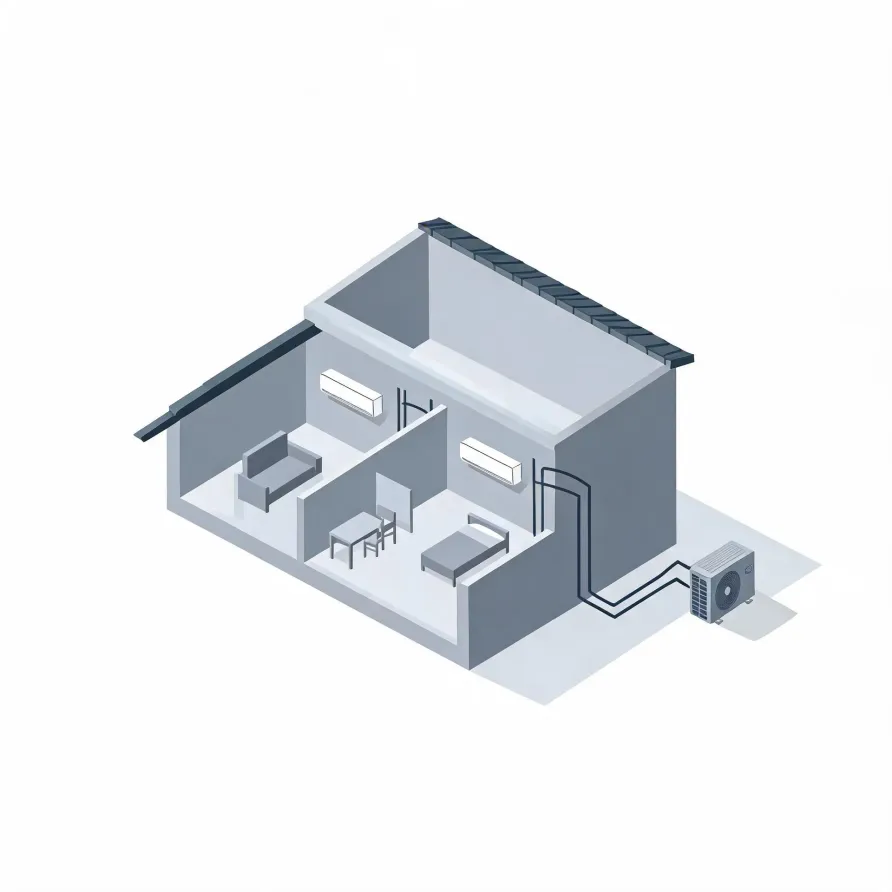
The indoor air handler mounts high on an interior wall, usually in the room you want conditioned, and moves air across the space. The outdoor condenser unit sits on the ground or a bracket outside the house and holds the compressor and the hardware that drives the whole system.
A refrigerant line set runs through a small opening in the wall to connect the two units, carrying the working fluid between them. A condensate drain line runs from the indoor unit to an appropriate discharge point, and a dedicated power supply connects to the outdoor unit.
The drawing shows a typical layout, and a licensed contractor determines what the installation requires for your specific home.
Get matched in Union CountyUnion County, Georgia, by the numbers
60 severe weather events were recorded in Union County, Georgia between 2015 and 2024.
NOAA National Centers for Environmental Information, Storm Events Database, bulk CSV export, events 2015-01-01 through 2024-12-31.Half the homes in Union County, Georgia were built in 1995 or earlier (2020-2024 ACS 5-year).
U.S. Census Bureau, 2020-2024 American Community Survey 5-Year EstimatesUnion County, Georgia holds 15,164 housing units (2020-2024 ACS 5-year).
U.S. Census Bureau, 2020-2024 American Community Survey 5-Year EstimatesOwners occupy 84.4% of the occupied homes in Union County, Georgia (2020-2024 ACS 5-year).
U.S. Census Bureau, 2020-2024 American Community Survey 5-Year EstimatesSevere Weather Events in Union County
Weather patterns in a given area set the real workload for heating and cooling equipment. A mini-split sized and installed for local conditions handles the demands that local weather actually places on it.
60 severe weather events, 2015–2024. Source: NOAA National Centers for Environmental Information, Storm Events Database.